|
|
|
|
|
|
|
|
|
|
|
|
|
|
|
|
|
|
|
|
A Field Guide to Defusing Workplace Conflict
Picture this—a cross-functional team of fisheries biologists, hydrologists, and habitat specialists sitting around a conference table, the week before a high-profile public hearing. They're to deliver consensus recommendations to a panel of policymakers on a contentious water allocation issue—with news media in attendance.
Instead, they're stuck in their fifth of six meetings arguing about whether the coho salmon data from 2019 is robust enough to support flow recommendations. Somehow, despite everyone's expertise and good intentions, the team has devolved into a positional argument over whose interpretation of that year's data is correct. The public hearing approaches. The deadline looms. And the message this group of experts is about to deliver is very visible: "We couldn't agree."
If you've spent any time in natural resource management, you've either witnessed this scenario or lived it. The request for advice, the pressure to perform, and the consequences of failure go together. And the consequences are real: damaged credibility with decision-makers, strained relationships with colleagues, and that gnawing feeling that you let everyone down—including the resource you're supposed to be protecting.
Here's the good news: this situation is manageable. Controllable, even. But it requires a specific conflict resolution skill that most of us were never taught in graduate school—the ability to name what's actually happening in the room and then do something productive with it. Master this skill, and you become the person who rescues meetings, builds your reputation, and actually goes home at a reasonable hour instead of cycling through another contentious email thread at 10 PM.
Conflict Resolution
= Recognition + Interests + Golden Question
Before we break down
each component, understand what you're doing with this formula: you're helping
a group of smart, well-intentioned professionals get out of their own way.
They're just stuck in a pattern that feels like productive debate but is
actually destructive conflict. This formula breaks that pattern. It's that
simple.
When tensions rise,
the instinct is to either power through the discomfort or avoid it entirely. We
think if we just stay focused on "the work," the conflict will
resolve itself. It won't.

Here's what
psychology tells us: Emotional arousal narrows our cognitive focus. When people feel
threatened or frustrated, their brains literally shift into a defensive mode
where they're processing information through a fight-or-flight lens rather than
a collaborative problem-solving one. Neuroscientist Dan Siegel calls this
"flipping your lid"—when the prefrontal cortex (responsible for
rational thought) temporarily loses its influence over the amygdala (the
emotional alarm system) (Siegel, 2012, The Developing Mind: How Relationships and the Brain
Interact to Shape Who We Are, 2nd ed., Guilford Press).
The act of naming
what's happening—acknowledging the conflict explicitly and in neutral terms—does
something neurologically important: it activates the brain's language centers,
which helps re-engage the prefrontal cortex. Research in affect labeling shows
that simply putting feelings into words reduces emotional intensity. You
literally calm the amygdala by naming what it's reacting to (Lieberman et al.,
2007, "Putting feelings into words: Affect labeling disrupts amygdala
activity in response to affective stimuli," Psychological Science, 18(5),
421-428).
But here's the
critical part: it's not enough to just point out that there's conflict. You
need to name it correctly. You need to name the underlying Interests, not the
Issues.
Issues are what people say they want—their demands,
proposals, or positions. Issues are the surface-level statements that sound
like solutions but are actually just opening bids in a negotiation to address
what the speaker "wants."
Common Issues in
natural resource workplace conflicts include:
When the
conversation stays focused on Issues, you get predictable results: right vs.
wrong debates where people defend their positions and attack others' points of
view. It's intellectual trench warfare—great for advancing scientific
knowledge, not so great for developing consensus scientific advice.
Interests are why people want their Issues
addressed—the underlying needs, values, worries, or goals driving their
positions. Interests are the reasons people take a position on the Issues. It's
what the speaker "needs" and hopes their position on the Issues will
provide.
Common Interests underlying those same conflicts could
be:
See the difference?
Issues are the "What" of a dispute. Interests are the "Why" those Whats matter.
When you name Interests, you expose the real needs, and in doing that, you open the door that leads to resolution. When people discuss their Interests, they tend to identify core concerns that, if addressed, allow them to let go of their rigid positions on the Issues.
The key is to name
the underlying Interests rather than simply paraphrasing the Issues back at
people.
Instead of this: "It seems like there's
disagreement about whether to use the 2019 or 2022 dataset" (naming the
Issue).
Try this: "It sounds like some of us are
concerned about the scientific credibility of our recommendations, while others
are worried about having robust enough data to meet the decision timeline. Both
of those are legitimate concerns" (naming the Interests).
See what happened?
The conflict shifted from opposing positions (2019 vs. 2022) into shared
concerns (credibility and meeting the deadline) to be addressed together.
Nobody has to be wrong. Both Interests can be simultaneously valid.
Here's what this
looks like in real time. When you notice rising tension in a meeting, pause and
neutrally point out what you observe:
"I'm noticing
some strong feelings about this approach. It seems like we have some important
concerns on the table—can we take a moment to identify what matters most to
each of us about using or not using these data?"
Then listen for the
Interests beneath the Issues, and say them back to your team:
"So, on one
hand, there's a need to make sure our scientific credibility doesn't suffer. On
the other hand, there's concern about deciding so we can meet the deadline.
What's an approach that can accommodate both?"
This reframing is
powerful because it makes the problem a shared focus rather than a you vs. me
debate. You've changed the discussion from people fighting each other to people
fighting the problem together.
Now here's where it
gets interesting. Once you've named the Interests, you need to move the
conversation forward with an action step. This is where most facilitations
stall out—people nod along, agree that yes, those are the concerns, and then...
nothing changes because they continue to debate about who is right instead of
problem-solving on doing the best you can with what you have.
You need to ask the Golden
Question—gold because it's an extremely valuable asset for nudging the
conversation from conflict to resolution.
The formal version: "What would need to happen so
that [Interest A] is addressed in a way that also works for [Interest B]?"
Or, in everyday
language: "What do you
most want to see happen that will work for you so you can get [your Interest]
met in a way that will also work to meet [the other person's Interest]?"
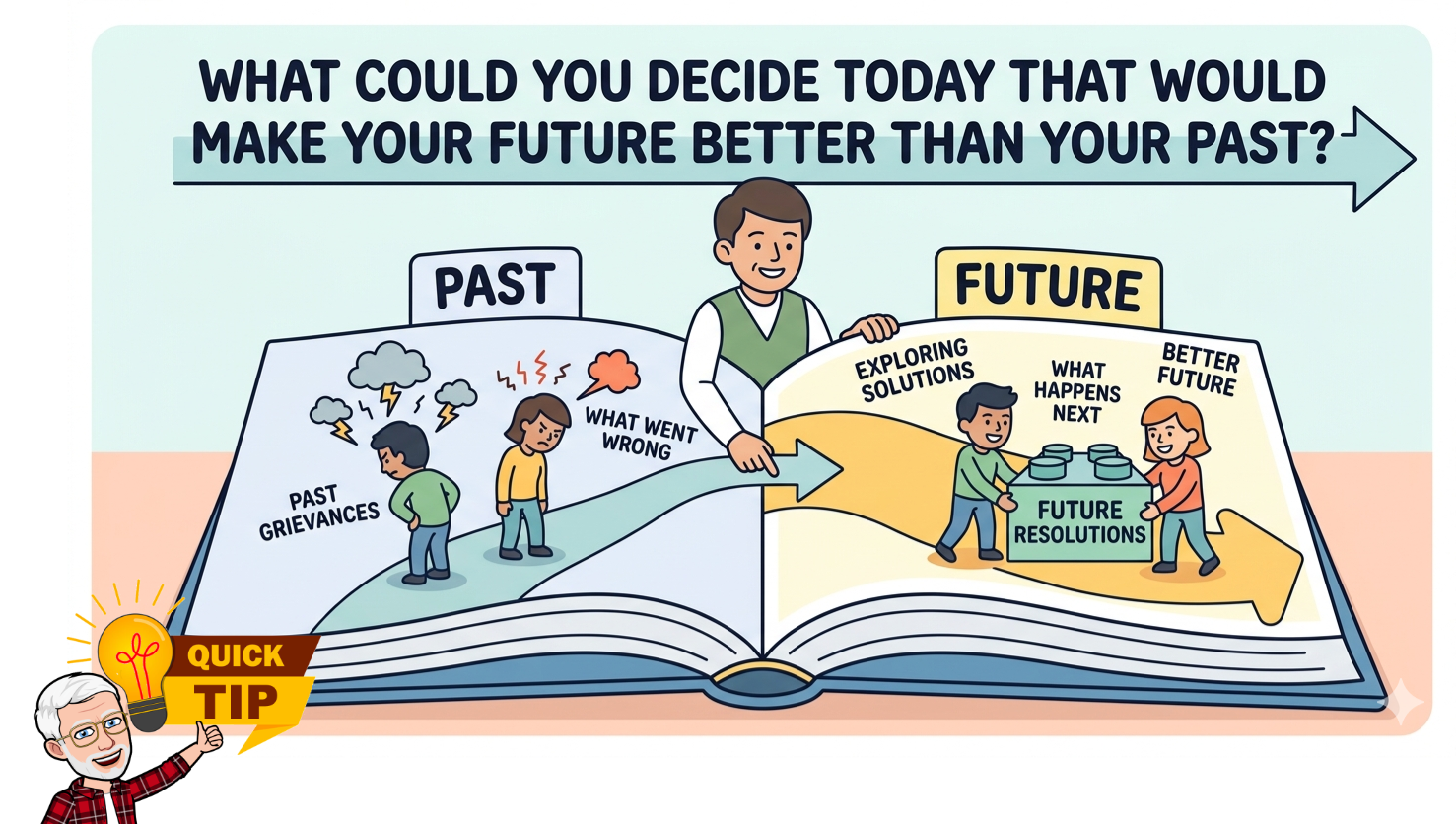
This question does
something crucial: it shifts people from a past orientation (where the
complaints live) to a future orientation (where solutions live). It transforms
positional statements into shared problem-solving opportunities. It forces
creative thinking instead of defensive argumentation.
Back to our dataset
debate:
"What would
need to happen so we can maintain scientific credibility while also meeting our
decision timeline with the available data we have?"
Suddenly, you're not
arguing about 2019 vs. 2022. You're problem-solving together about how to meet
both needs. Maybe that means using the 2019 data, but being explicit about
limitations in the report. Maybe it means a phased approach. Maybe it means a
with-and-without comparison. Maybe it means something nobody has thought of yet
because they've been too busy defending their positions.
The Golden Question
unlocks creative solutions by getting people unstuck from their positions on
the Issues and focused on getting their needs met by addressing their
underlying Interests.
So, here's your
formula for managing conflict when it shows up:
Conflict Resolution
= Recognition + Interests + Golden Question
And it all begins
with: If you can name it, you can tame it.
The payoff? You walk
out of that contentious meeting with a consensus recommendation instead of an
embarrassing admission of failure. You build a reputation as the person who can
navigate tough conversations and deliver results. Decision-makers increase their
trust because they get consistent, actionable advice. And you spend less time
managing interpersonal drama that gets in the way of decision-making.
That dataset debate
you were stuck in? It gets resolved by the deadline. The public hearing? Your
team shows up unified, confident, and prepared. Your professional reputation?
Enhanced.
All because you
could Name It To Tame It!
What workplace conflicts are you facing that could benefit from naming the underlying Interests? Hit reply and let me know—I read every response.
Free Consultation - Just Ask!
I offer free consultations on conflict, facilitation, difficult meetings, public involvement, online meetings, and collaboration in general. Schedule an opportunity to talk with me about your issue. I promise not to trap you into a marketing message. We will stick to problem-solving on your issue.
With Conflicting Priorities Mapping
A simple facilitation technique to move your group from 'my way vs. your way' to collaborative problem-solving.
You're 20 minutes into the discussion and you can feel it: the conversation is changing into a debate.
Maria keeps pushing for speed—"We need to move on this now to capture market share." Tom keeps insisting on accuracy—"We need to slow down to avoid mistakes." Each time one speaks, the other tightens up. The rest of the group has gone quiet, waiting to see who wins the tug of war.Sound familiar?
The Real Problem: Competing Priorities
Here's what's actually happening: your group is facing a legitimate tension between two valid priorities. But because the conversation has turned into Maria vs. Tom—or Speed vs. Accuracy framed as an either/or choice—everyone's treating it like a debate to be won rather than a problem to be solved.
When priorities conflict, meetings stall because people:
The real pain? Smart people spend hours talking past each other, relationships get strained, and the actual problem—how to honor both priorities—never gets addressed.
The Solution: Make the Competing Priorities Visible
Conflicting Priorities Mapping is a facilitation tool that moves groups out of polarized debate by creating a neutral structure for comparing competing concerns. Instead of people arguing, you give the group something concrete to look at together—a shared picture of what's actually in tension.
The tool works by separating a discovery from an evaluation conversation. First, you capture what each priority is trying to accomplish. Only then do you work on resolving the tension.
This shifts attention from people to priorities, ensures each perspective is heard without judgment, and sets the conditions for integrative problem-solving rather than either/or thinking.
On a flip chart, whiteboard, or shared screen, draw a
simple T-chart or multi-column chart. Label each column with the competing priorities as the group names them. Keep the labels neutral and parallel:
✔️ Speed | Accuracy
✔️ Innovation | Stability
✔️ Cost Containment | Quality Service
2. Pause debate before it starts
This is critical. Say something like: "Before we try to solve this, let's make sure we understand what each priority is protecting. This is a no-discussion phase—we're describing, not debating or problem-solving yet.
You're creating a container that temporarily suspends judgment so both sides can be fully heard.
3. Capture underlying needs
Invite participants to list what each priority (each column) is trying to accomplish, protect, or avoid. Record their language as short, neutral phrases in the appropriate column.
When someone starts arguing or comparing, redirect them: "Hold that thought—right now we're just capturing what each side is trying to achieve."
Useful prompts:
✔️ "What does success look like from this perspective?"
✔️"What risk is this priority trying to prevent?"
✔️"What would be lost if we ignored this?"
✔️"What value is this protecting?"
Continue until the group agrees the chart fairly represents all perspectives. You'll know you're done when people start nodding and the room relaxes slightly—they feel heard.
4. Reflect before solving
Once your map is complete, pause again. Don't jump straight to solutions. Ask observation questions that help the group see patterns:
✔️ "What do you notice when you see these side by side?"
✔️ "Where do these priorities already overlap?"
✔️ "Which tensions are real, and which may be assumed?"
✔️ "What would honoring both look like?"
This reflection phase is where insight happens. Often, people discover the conflict isn't as binary as they thought, or they identify a creative approach neither side had considered when they were busy defending their position.
Only after this reflection should you move toward solutions or decisions.
When to Use This Tool
Reach for Conflicting Priorities Mapping when:
✔️ Discussions are stuck in positional conflict.
✔️ People feel unheard or dismissed.
✔️ The same argument keeps resurfacing.
✔️ Power dynamics make open disagreement difficult.
✔️ Smart people are talking past each other.
✔️ You sense the group has a solvable problem but can't get to it.
This tool pairs naturally with Both/And Thinking—a tool for finding integrative solutions by asking the group to suggest options that address both needs at the same time.
Common Pitfalls
Watch out for:
⚡Debate creeping in during capture: Someone starts arguing why their priority matters more. Redirect: "We'll get there—right now we're just listing what each side is trying to protect."
⚡One voice defining another's priority: Tom tries to articulate what Maria's priority means. Redirect: "Let's hear from Maria directly about what matters from that perspective."
⚡Jumping to solutions too early: Before the map is complete. Redirect: "Good thought—let's capture it for later. First, let's finish painting the full picture."
What Success Looks Like
Done well, Conflicting Priorities Mapping gives your group something concrete to work with instead of something to argue over.
You'll know it's working when:
✔️ The energy in the room shifts from defensive to curious.
✔️ People start building on each other's points instead of countering them.
✔️ Someone says, "Oh, I didn't realize that's what you were concerned about."
✔️ The group discovers solutions that honor both priorities.
✔️ The conversation moves from "your way or my way" to "our problem to solve together."
Sometimes the sharpest truths about conflict don’t come from textbooks or theories—they come from the lived experience and wisdom of people dealing with everyday challenges.