When Your Conflict Conversation Gets Stuck in the Past
“Give the past a voice in the room — not a veto.” |
|
|
You know the feeling. The conversation is going nowhere, the same grievances keep surfacing, and no matter what you try, nothing moves forward. When conflict gets stuck in the past, it can feel like there’s no way forward. But there is. It starts with a simple turning of the page. |
When conflict breaks out in a meeting, a negotiation, or a working relationship, our instinct is entirely understandable: we want to figure out what went wrong. Who did what? Who said what? Whose decision caused this? That impulse makes sense. We are wired to evaluate, critique, and assign responsibility based on what has already happened. The past feels like solid ground — documented, verifiable, real. But in practice, a backward focus tends to produce the same three outcomes every time: |
- Positions harden
- Blame increases
- Progress stalls
|
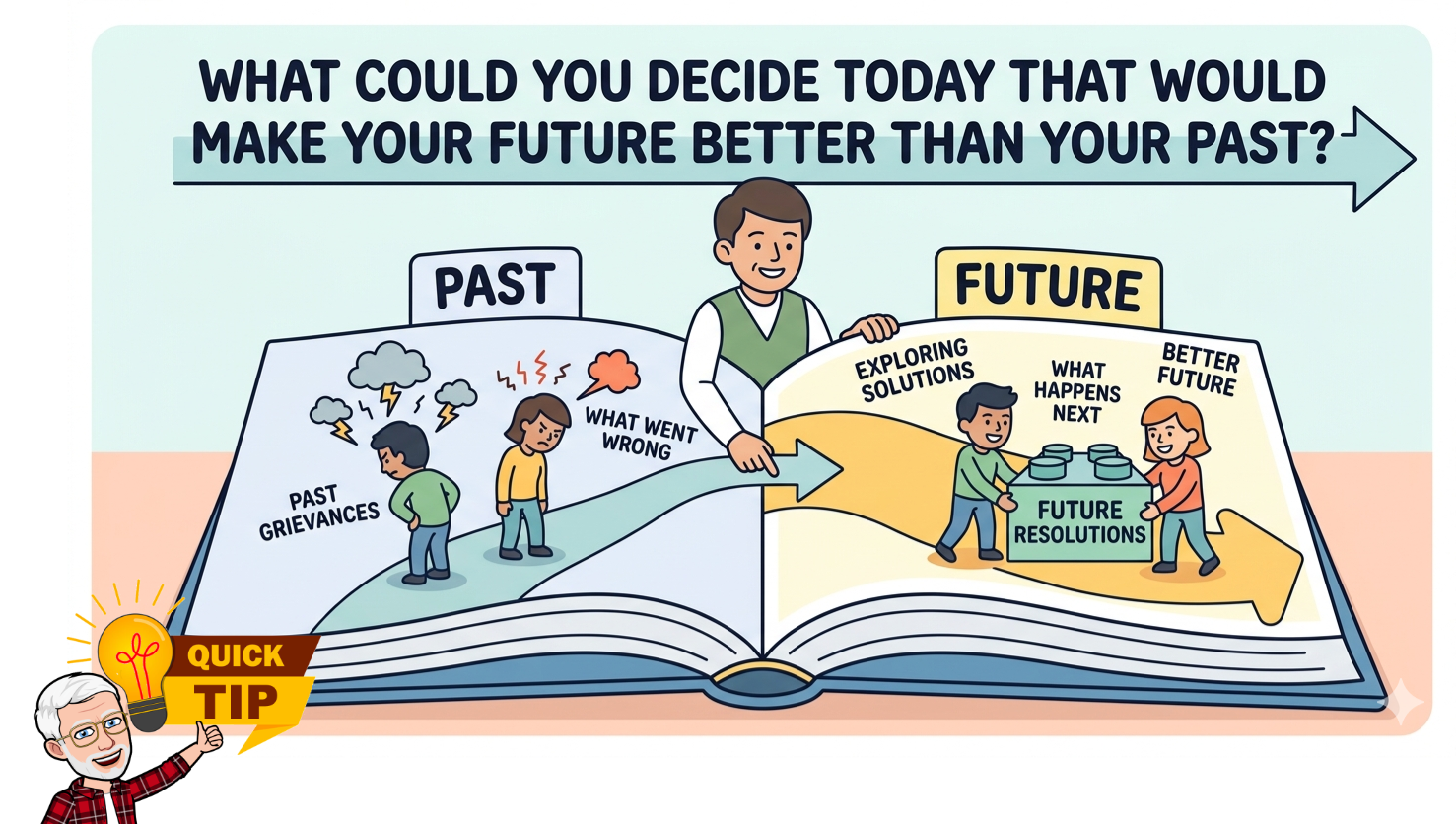
At some point, continuing to analyze the past stops being useful. You’ve heard the concerns. You understand the history. And yet the conversation keeps circling back to the same grievances and the same accusations that lead to impasse. That's the moment to turn the page — to close the chapter on what went wrong and open a new one around what comes next. |
Why the Future Changes Everything |
|
|
Future-focused conversations have fundamentally different properties than backward-looking ones. Once you shift from “what happened” to “what happens next,” the whole dynamic changes. |
| |
|
Future-focused conversations have fundamentally different properties than backward-looking ones. Once you shift from “what happened” to “what happens next,” the whole dynamic changes. Past-focused conversations are easy to argue about. They invite contradiction. They rehash fixed positions and assign blame. Future-focused conversations are harder to argue about. They invite contributions. They create options. They build shared goals. Consider the difference between these two questions: “Who was right?” — vs. — “What would work going forward?” That is not just a different question. It is a fundamentally different conversation. The first question locks people into their positions and into their history. The second invites them into co-creation — working together to write the next chapter. Shifting the focus from what happened to what happens next allows parties to identify shared goals and, ultimately, to construct more durable agreements, putting the conflict behind them. |
How to Make the Shift (Without Forcing It) |
A direct pivot rarely works. If you try to skip past someone’s grievance before they feel heard, they will simply pull you back to it — harder. People need to feel that the past has been acknowledged before they can let it go. Here are three steps to make the shift to the future: |
Step 1 — Acknowledge the past, briefly and respectfully |
Signal that the history matters, without inviting more debate. You are not dismissing what happened, nor are you agreeing or disagreeing with that history; you are receiving it. “It sounds like there are real concerns about how this unfolded.” “I’m hearing that past decisions are still affecting the trust here.” |
Step 2 — Draw a boundary around it |
Gently close the loop on continued re-analysis. You are not declaring the past irrelevant — you are naming the limit of how far a backward-facing analysis can take you. “We may not be able to resolve every detail of what happened…” “We could keep unpacking this, but it may not move us forward…” |
Step 3 — Open the door to the future |
Shift the frame explicitly. Use questions that make the future concrete and reachable. “What would a workable path forward look like?” “If this were going well six months from now, what would be different?” “What do we need to put in place so this works better going forward?” “Given everything we’ve discussed, what’s one step we could take next that would improve things?” Questions like these work because they are small, practical, and forward-looking. And because it lowers the bar — you are not asking for the whole solution. Just the next step. |
Notice what these questions do, and not do: they don't ask people to abandon their concerns, forgive what happened, or agree with the other party. They simply ask them to look in a different direction — toward something they might be able to build together. That is how you turn the page. One question. One step. And a conversation that finally moves into the next chapter. |
Michael Fraidenburg is the founder of The Cooperation Company, providing training and consulting in negotiation, facilitation, and conflict resolution for natural resource professionals. |
Michael (Mike) Fraidenburg, at The Cooperation Company
Washington Mediation Association Certified Mediator |
|
|
|


 Tip: How To Easily Manage Conflict With Golden Questions When your conversation needs to get past debating who’s right and wrong, golde...
 Stuck in the Past? Moving Forward When Identities Collide We Are What We Think We Are The way we see ourselves, our “identity,” ca...